One SPV per property. Two ways in. Fiat and crypto out.
ONNVO isn't a listings marketplace bolted onto a payments flow. It's a structure: every asset sits in its own dedicated special purpose vehicle, supply arrives through two distinct channels, capital can move in fiat or regulated stablecoins, and every investor-facing feature is switched on only when the corresponding licence permits it.
What makes a fractional platform defensible isn't the app. It's what feeds it.
A checkout flow is easy to copy. ONNVO is built around two structural edges that compound instead: a supply channel most competitors don't have, and a settlement layer built for where money is actually heading.
Owner staking
Existing holders of Dubai property become a distribution channel, not just an acquisition target — supply that scales with the market's existing stock, not with ONNVO's own deal-sourcing headcount.
Digital currency rails
Funding and payouts in regulated, fiat-pegged stablecoins alongside conventional banking — built for a world where digital currency is becoming the default rail for global capital, not a niche one.
Formation
A dedicated SPV is incorporated for the single property, with its own bank account, governance, and cap table.
Title & contribution
The property's title is transferred into the SPV, either through direct acquisition or an owner's contribution, with encumbrances, insurance, and reserves recorded before anything lists.
Investor issuance
Registered members subscribe to shares in the SPV. Ownership is recorded directly in the share register — a legal interest, not a claim on ONNVO.
Operations
The SPV collects rent, pays expenses, and distributes net income pro rata, with tenants and covenants monitored and periodic reports published to investors.
Exit
Proceeds from a sale or buyback are distributed net of costs under the SPV's own governance, and the vehicle is closed or recycled.
Illustrative structure — box count and labels are representative, not a count of real assets today.
The same underwriting bar applies whether an asset is acquired or staked in.
A second supply channel only strengthens a platform if it's held to the same standard as the first. Every property — acquired or staked — clears the same checks before it becomes an SPV.
WAULT & tenant credit
Weighted Average Unexpired Lease Term is calculated per asset, weighted by rent, and cross-checked against tenant covenant strength — the standard commercial real estate underwriting metric, applied here to residential and commercial alike where leases exist.
Independent valuation
Every staked asset is valued by an independent, RICS-aligned methodology before it lists — the same standard applied to acquired assets, so an owner contributing a property can't set its own entry price.
Reserve policy
Each SPV holds a cash reserve sized to a set number of months of operating costs and debt service before any distribution is calculated, so a vacancy or repair doesn't immediately interrupt investor payouts.
Owner staking is the part that scales.
A platform that only sources deals itself is bounded by its own acquisitions team. ONNVO's second channel lets an owner who already holds a deed contribute that asset into a dedicated SPV and list it — turning existing holders of Dubai property into a distribution channel, not just a supply source.
Acquired
CH — 01ONNVO sources, underwrites, and structures the asset directly.
Staked
CH — 02An owner contributes an asset they already hold.
Residential and commercial from day one.
Most fractional entrants start residential-only. ONNVO underwrites commercial alongside it from the outset, which diversifies income across tenancy types and cycles rather than concentrating in one.
Residential
Income-producing apartments and villas across Dubai's established and high-growth micro-markets.
Grade-A office
Commercial space underwritten on tenant credit and weighted average unexpired lease term (WAULT).
Logistics & co-living
Income-stable formats gaining share as investors look past residential cycles for diversification.
Digital currency isn't a payment nicety here. It's a market.
Fiat rails serve the audience every platform already reaches. A growing share of global and diaspora capital now sits in stablecoins rather than bank accounts — investors who want GCC real estate exposure but don't want to route through a correspondent bank to get it. Building fiat and digital-currency rails in parallel from the start, rather than retrofitting one later, is a deliberate market-access decision, not a technical afterthought.
The direction every major economy is moving
India's e₹ digital rupee is already live and expanding. The US has chosen to formally regulate dollar-backed stablecoins at a federal level rather than restrict them. The EU's MiCA framework brought stablecoins fully inside regulatory scope. The UAE itself is developing a central bank digital currency alongside a fast-growing market of dirham-pegged stablecoins. The pattern is consistent across every major economy: digital currency is being pulled inside the regulatory perimeter, not pushed outside it.
Not a bet on crypto volatility
This isn't exposure to speculative crypto assets. Funding and distributions would move through regulated, fiat-pegged stablecoins — value held and settled in AED or USD terms, moved over faster rails, not a token whose price an investor has to track. The SPV's books and an investor's return stay denominated in real estate terms, regardless of which rail moved the money.
Fiat
Cards, bank transfer via SWIFT, SEPA for European accounts, and local payment methods including UPI for the India corridor — the familiar path for investors who want it, wherever their bank sits.
Stablecoin on-ramp & off-ramp
Funding an SPV subscription and receiving rental distributions or exit proceeds in regulated, fiat-pegged stablecoins, via licensed virtual-asset service providers — for both investors and owners staking in an asset.
CBDC-ready
As central bank digital currencies mature — India's e₹, a prospective UAE CBDC, and others that follow — the same rail architecture is designed to plug into them without redesigning the ownership or settlement layer underneath.
Planned capability, staged behind the required licences — including any virtual-asset authorization (e.g. VARA) alongside DFSA. Not a live service today.
This isn't a UAE-only bet. The whole Gulf is moving the same direction.
For a platform built to reach Gulf-based and Gulf-focused capital specifically, the region's own central banks are part of the timing argument, not just the country a given property sits in.
UAE — Digital Dirham
The Central Bank of the UAE has been developing a Digital Dirham under its Financial Infrastructure Transformation programme, with cross-border wholesale settlement already piloted through Project mBridge alongside other regional and global central banks.
Saudi Arabia — SAMA
SAMA ran one of the region's earliest cross-border CBDC pilots — Project Aber, a joint settlement trial with the UAE's central bank — and has continued as an active participant in multi-CBDC initiatives since.
Bahrain & the wider Gulf
Bahrain's central bank has positioned itself as one of the region's most proactive digital-asset regulators since 2019, and GCC central banks have a long history of monetary coordination that makes regional interoperability a realistic, not speculative, direction.
None of this is live for ONNVO today, and each item above is a central bank's own program, not ONNVO's. The point is directional: a platform built with digital-currency rails from the start doesn't need to retrofit for a Gulf where CBDCs are normal — it's already pointed that way.
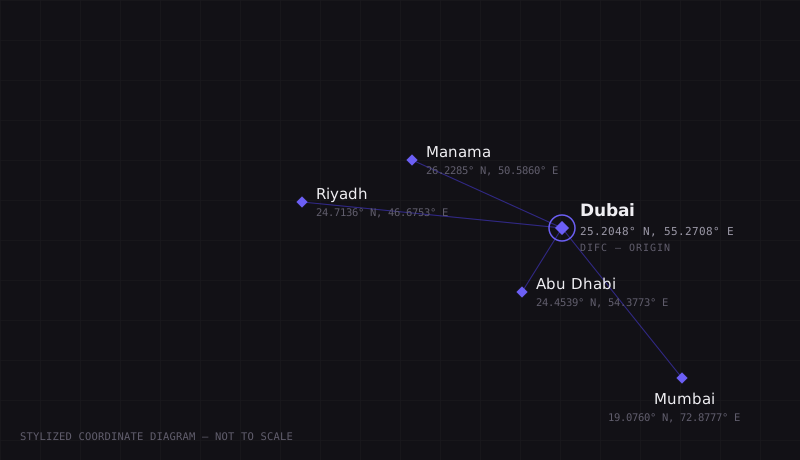
The same corridors as the Reach Register on Thesis — each is a live or piloted CBDC/digital-currency program in its own right. Stylized coordinate diagram, not a scaled map.
Mobile-first, built for people who don't live in Dubai.
Onboarding & eKYC
Digital identity verification and investor categorization, designed for a global and multilingual member base, not just UAE residents.
Portfolio & distributions
A live view across every SPV held, with rental distribution statements, occupancy updates, and valuation refreshes in one place.
Recurring investing
An optional SIP-style contribution schedule for investors who'd rather build a position gradually than commit in one ticket.
Owner portal
The staking-side counterpart — intake, a data room for diligence documents, and listing-lifecycle tracking for owners contributing an asset.
Every consumer-facing feature is gated until the licence for it exists.
ONNVO is currently in Stage I. Stages II–IV are the forward plan, not a status already achieved.
Establish & build
Entity incorporation, a DIFC flexi-desk, Data Protection registration, and the initial governance framework — used to build product and run non-regulated features while the platform is prepared.
Regulated crowdfunding
Authorization to operate a property-based or investment-based crowdfunding platform — client agreements, disclosures, retail exposure caps, and reporting, with an optional supervised-testing period ahead of full authorization.
Crypto rails, licensed
Onboarding a licensed virtual-asset service provider and securing the corresponding authorization before crypto funding or payouts go live for any investor.
Investor protections
Standardized key information documents and risk warnings on every listing. Investor categorization and exposure caps where applicable. Strict segregation of client assets, with no client-money handling until authorization is live.
Marketing compliance
Public content stays education-led. Detailed offers are presented only inside a member-only, registered environment — not broadcast as open solicitations, in line with DFSA financial promotions expectations.
Four ways ONNVO earns — each tied to a different moment in the asset's life.
Acquisition — 1.0–2.0%
A one-time fee on property value when ONNVO sources and structures a property into an SPV, whether acquired directly or staked in by an owner.
Administration — ~1.0% of SPV NAV, annually
An ongoing fee for managing the SPV — reporting, distributions, and platform infrastructure — that scales with total assets on the platform.
Property operations — 5–8% of rent
A spread on property management, delivered through third-party or partner managers rather than an in-house operations team.
Secondary spread — 0.5% per side
A transfer fee on secondary trading, once a share transfer facility is authorized — not available at launch.
Full three-year projections, unit economics, and sensitivity assumptions are on the Financials page.
The register doesn't have to be ours alone to use.
Everything above — SPV formation, the compliance stack, owner-staking intake, the settlement rails — is infrastructure ONNVO has to build regardless. Once it exists and is proven on ONNVO's own volume, the same layer can be licensed to brokers, developers, wealth managers, and banks who need SPV-backed fractional infrastructure and don't want to build or license it themselves.
The precedent already exists, in venture
Carta built SPV formation and cap-table administration into core infrastructure for venture investing. AngelList's Sydecar went further — a pure "SPV-as-a-service" layer that lets any fund manager stand up a special purpose vehicle in days, without building the legal, banking, and compliance stack themselves. Both are now default infrastructure most venture investors use without a second thought.
Real estate hasn't had its equivalent yet
No comparable "SPV-as-a-service" layer exists for real estate at the scale Carta and Sydecar reached in venture — most fractional real estate platforms build their SPV and compliance machinery purely for internal use, not to license outward. If ONNVO's own volume proves the infrastructure works, licensing it outward is the same playbook applied to a market that hasn't seen it yet.
Setup & integration
A one-time fee to onboard a partner onto ONNVO's SPV templates, compliance stack, and API — the same infrastructure ONNVO uses for its own listings.
Platform access
A recurring subscription or per-SPV administration fee for ongoing use of the formation, reporting, and distribution infrastructure.
Usage spread
A small spread on GMV processed through the API by partners — the same mechanism as ONNVO's own acquisition and administration fees, applied to someone else's deal flow.
Phase 3+ optionality, sequenced after ONNVO's own DFSA authorization — not a current product, and not counted in the base-case model on the Financials page. No partners or pricing exist today.