Why fractional real estate, why the GCC, why now.
Real estate is already the world's largest asset class, and fractional access to it is already a proven model. This page sets out why that model is underbuilt in the Gulf specifically, who else is already building toward it, and why the window to build it compliantly is open now rather than indefinitely.
| Market segment | Annual value | Foreign investor share | Local investor share |
|---|---|---|---|
| UAE total real estate | $136B+ (AED 500B+), 2024–25 est. | ~40–45% (Dubai: $54B) | ~55–60% |
| GCC total real estate | $1.5T by 2026 | ~35–40% avg. | ~60–65% |
| GCC proptech investment | $500M+, 2023–25 | ~60% cross-border | ~40% |
| Fractional / proptech-driven UAE | AED 5–10B ($1.4–2.7B) | ~50–65% | ~35–50% |
Figures are third-party and internal market estimates, presented for context. They describe the addressable market, not ONNVO's results.
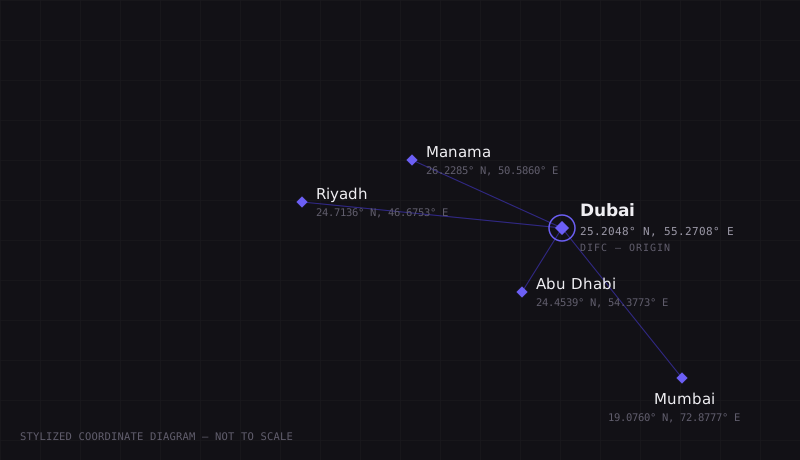
Reach Register — the GCC and diaspora corridors ONNVO's model and rails are built to address. Stylized coordinate diagram, not a scaled map.
Access hasn't kept up with demand.
Dubai's real estate market is thriving and foreign capital is already flowing into it at scale. What hasn't scaled is the mechanism ordinary global investors use to participate — most of that AED 500B in annual flow still runs through brokers, developers, and relationships, not a regulated digital platform.
Ticket size
Direct ownership in Dubai typically starts well into six figures (AED), pricing out most global retail and diaspora capital that would otherwise want exposure to the market.
Cross-border complexity
A non-resident investor typically needs local legal counsel, SPV structuring knowledge, and an on-the-ground relationship before they can transact — friction that scales with distance from Dubai, not with capital available.
Opaque structures
Where fractional vehicles do exist, ownership is often a financial claim on a manager rather than a registered legal interest — a distinction that matters enormously in a downturn or a dispute.
Rails
Funding and payouts assume a bank account in the right currency and jurisdiction — a poor fit for the growing share of global capital that now moves natively in stablecoins.
A category with players, not yet a leader.
Dubai already has several regulated fractional real estate platforms — that's evidence the model works, not that the opportunity is closed. Looking at how they're built points to what's still open.
What's common across current entrants
Supply sourced by the platform itself, with no channel for existing owners to bring in assets. Residential-first, with commercial treated as a later expansion. Fiat-only funding and payouts, routed through conventional banking rails. Fast, consumer-app growth, with regulatory scope often expanding after launch rather than before it.
Where ONNVO is built differently
A second supply channel — owner staking — that recruits from Dubai's existing stock of held property, not just new acquisitions. Residential and commercial underwritten together from day one. Fiat and regulated digital-currency rails planned in parallel, not bolted on later. Every consumer-facing feature gated behind the licence that covers it, from incorporation onward.
| Platform | Market | Regulatory status | Supply model | Asset scope | Settlement rails |
|---|---|---|---|---|---|
| Smartcrowd | UAE | DFSA-regulated | Platform-sourced | Residential-first | Fiat only |
| Stake | UAE | Publicly positioned as regulated | Platform-sourced | Residential-first | Fiat only |
| Prypco | UAE | Publicly positioned as regulated | Platform-sourced | Residential-first | Fiat, tokenization explored |
| Fundrise | United States | SEC-qualified (Reg A+) | Platform-sourced | Diversified funds | Fiat only |
| RealtyMogul | United States | SEC-registered offerings | Platform-sourced | Commercial + residential | Fiat only |
| ONNVO — planned | DIFC, UAE + GCC | DIFC Innovation Licence → DFSA pathway, not yet granted | Platform-sourced + owner-staked | Residential + commercial, day one | Fiat + regulated stablecoin rails |
Compiled from each platform's own public-facing materials as of this writing, for structural comparison only — not a claim of endorsement, affiliation, or superiority in outcomes. Regulatory status can and does change; verify current status directly with each platform or its regulator. ONNVO's own row describes a pre-launch plan, not a live or authorized service.
Where the numbers on this page come from.
Every market figure on this site is either a cited public estimate or an internal planning assumption — never a result, because ONNVO has none yet. Here's which is which.
UAE & GCC transaction values
Blended from publicly reported Dubai Land Department transaction bulletins and third-party regional real estate research (brokerage and consultancy market reports), presented as ranges rather than false precision.
Foreign investor share
Estimated from publicly reported nationality breakdowns of Dubai property registrations, which vary by reporting period and methodology — presented as an approximate range, not a precise figure.
Fundrise & RealtyMogul figures
Taken directly from each company's own public reporting (investor communications and public statements), cited for market-context only. Neither company is affiliated with or endorses ONNVO, and past performance elsewhere is not indicative of ONNVO's future results.
CBDC & stablecoin regulatory developments
Drawn from public central-bank and regulator announcements (UAE Central Bank, SAMA, RBI, US federal legislation, EU MiCA) — each is a named institution's own program, not a claim about ONNVO's current capabilities.
ONNVO's own projections
Internal planning assumptions built from the figures above plus management's own modeling — clearly labeled as forward-looking throughout, and detailed in full on the Financials page.
Fractional real estate has already scaled to billions, elsewhere.
The US and Europe are several years ahead of the GCC on this model. What they show is a ceiling, not a cap — the category scales once a platform earns trust at volume.
Capital deployed annually into real estate, per company reporting
Individual investors on the platform, per company reporting
Property value offered on the platform since inception
Members, over a 10+ year operating history
Public, company-reported figures cited for market context only. Neither company is affiliated with or endorses ONNVO.
Fractional real estate has already been proven. The GCC is where that cycle is starting, not where it's already been decided.
Each of the markets above went through several years of fragmented, lightly regulated entrants before a small number of compliant, well-capitalized platforms consolidated the category. That pattern is now beginning in the GCC — DIFC and DFSA have built frameworks specifically for property-based and investment-based crowdfunding, which didn't exist when the earlier markets started.
That regulatory readiness is the first tailwind. The second is capital itself: a growing share of global, and especially diaspora, wealth now moves natively in digital currency rather than through bank rails — and every major economy is moving to formalize that, not restrict it. India's e₹ digital rupee is already live. The US has chosen to federally regulate dollar-backed stablecoins rather than ban them. The EU's MiCA framework brought stablecoins fully into regulatory scope. The UAE itself is developing its own central bank digital currency, and it isn't alone — Saudi Arabia and other GCC central banks have been piloting cross-border digital-currency settlement for years. See the Model page for the detail.
A platform built to accept funding and pay out distributions in regulated, fiat-pegged digital currency, alongside conventional banking, reaches a pool of capital a fiat-only platform structurally can't — without taking on crypto-asset price risk to do it.
See how ONNVO is built for both →The region is louder right now. Dubai's track record in moments like this is to get quieter and stronger.
This isn't a separate argument from the one above — it's the timing layer on top of it. Regulatory readiness and digital-currency tailwinds explain why the GCC is investable now. This explains why entering in the next window, specifically, matters.
A safe-haven pattern, not a coincidence
Dubai has a long, repeated track record: when the wider region grows less certain, capital and people move toward it, not away — a flight to stability that shows up as inflows, not outflows. That pattern is playing out again now.
Valuations haven't fully caught up yet
Safe-haven demand takes time to fully price into asset values. In the near term, that gap means a wider set of investable residential and commercial assets are available at valuations that haven't caught up to where the market is heading.
The window closes as conditions normalize
As the wider region stabilizes — which it will — recognition of Dubai's position typically broadens, competition for the best assets increases, and that pricing gap closes. Assets acquired ahead of that re-rating carry the advantage; assets acquired after it don't.
This compounds the core thesis, it doesn't replace it
The regulatory and digital-currency tailwinds above are structural — they don't depend on regional conditions. This entry-timing advantage stacks on top of them: the category is investable regardless, and the pricing is unusually favorable right now specifically.
Time is the input here. Every month a well-capitalized, compliant entrant waits is a month the gap closes for someone else instead.
What could go wrong, and what we do about it.
Regulatory scope creep
Mitigation: features are gated behind the specific licence that covers them; no client-money handling before DFSA authorization; compliance reviewed on a fixed schedule, not reactively.
Valuation & conflicts on staked assets
Mitigation: independent valuation methodology, documented related-party disclosure, and standardized key information documents before any staked asset lists.
Liquidity & investor expectations
Mitigation: hold periods and distribution schedules communicated upfront; a secondary transfer mechanism considered only once authorized; conservative reserves held at the SPV level.
Concentration
Mitigation: diversification across asset class and tenancy type from the first listings, with geographic diversification across the GCC planned as the portfolio matures.